Correct Use of Matras: A Beginner's Guide
For anyone learning to read and write in Devanagari script, mastering matras (मात्राएँ) represents one of the most crucial milestones. These seemingly small marks hold the power to completely transform the pronunciation and meaning of words. A single matra can turn "कल" (kal - yesterday/tomorrow) into "काल" (kāl - time/death) or "किल" (kil - nail). Understanding matras isn't just about technical accuracy; it's about unlocking the full expressive potential of the Devanagari script.
This comprehensive guide will take you from the fundamentals of what matras are to advanced usage, common mistakes, and practical exercises that will solidify your understanding.
What Are Matras?
The word "matra" (मात्रा) literally means "measure" or "quantity" in Sanskrit, but in the context of Devanagari script, it refers to the diacritical marks that represent vowel sounds when they follow consonants.
The Dual Nature of Vowels
To understand matras, you must first grasp a fundamental principle of Devanagari: vowels exist in two forms.
Independent Form: Used when a vowel appears at the beginning of a word or stands alone as a syllable. For example:
- अमर (amar - immortal)
- आम (ām - mango)
- इमली (imlī - tamarind)
Dependent Form (Matra): Used when a vowel sound follows a consonant. For example:
- कमल (kamal - lotus)
- काम (kām - work)
- किला (kilā - fort)
This distinction is unique and essential to Devanagari. Unlike English where 'a' always looks like 'a' regardless of position, in Devanagari, the vowel sound following a consonant transforms into a matra.
The Inherent Vowel: Foundation of the Matra System
Every consonant in Devanagari carries an inherent 'a' (अ) sound. When you write क, you're actually writing "ka," not just "k." This inherent vowel is automatically present unless:
- It's suppressed by a halant (्)
- It's modified by a matra
This concept is fundamental. When you add a matra to a consonant, you're not adding a vowel to a pure consonant sound—you're replacing the inherent 'a' with a different vowel sound.
The Complete Matra Chart
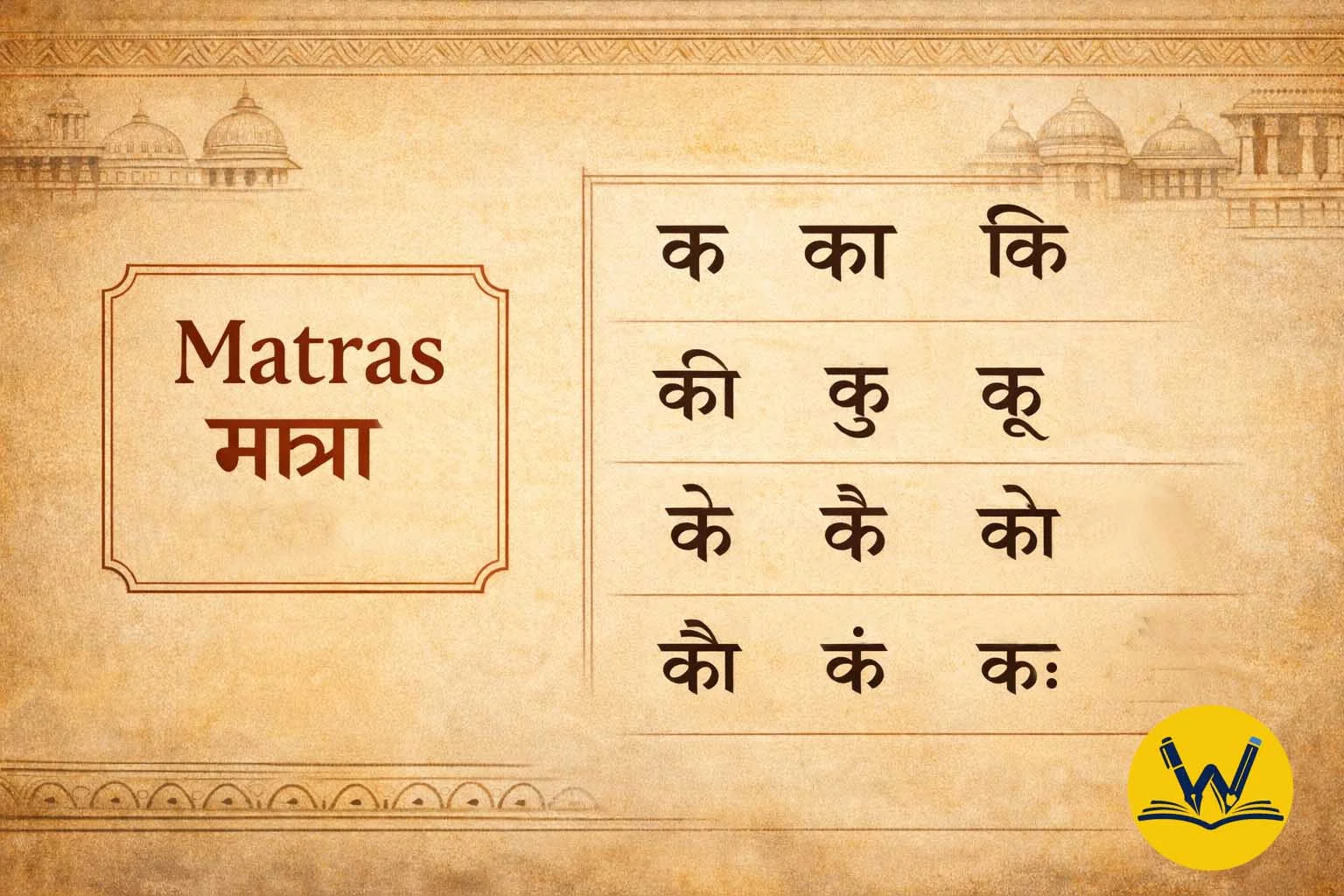
Let's systematically explore all matras using the consonant क (ka) as our base. Understanding how each matra attaches to this consonant will prepare you for using them with any consonant.
No Matra: The Inherent Vowel
क = ka (as in "comma")
This is the baseline. The consonant क naturally includes the short 'a' sound without requiring any additional mark.
आ-Matra (ा): Long 'a'
का = kā (as in "father")
Position: After the consonant
Form: A single vertical line (ा)
Visual Note: Extends downward from the shirorekha (headline)
Examples:
- बाबा (bābā - father, old man)
- माता (mātā - mother)
- पानी (pānī - water)
- बातचीत (bātchīt - conversation)
Common Mistake: Beginners sometimes confuse the vertical line of आ-matra with the letter ल (la). Remember, ला combines both the letter and the matra.
इ-Matra (ि): Short 'i'
कि = ki (as in "kit")
Position: BEFORE the consonant (unique feature!)
Form: A small curved stroke (ि) placed to the left
Visual Note: This is the ONLY matra that appears before the consonant it modifies, even though it's pronounced after the consonant sound.
Examples:
- किताब (kitāb - book)
- दिन (din - day)
- मिठाई (miṭhāī - sweet)
- किसान (kisān - farmer)
Common Mistake: Writing the matra after the consonant. Always remember: इ-matra goes BEFORE the consonant visually, even though phonetically it comes after.
Writing Order: Even though इ-matra appears to the left, you write the consonant first, then add the matra. For example, when writing कि, you first write क, then add ि to its left.
ई-Matra (ी): Long 'i'
की = kī (as in "key")
Position: After the consonant
Form: A vertical line slightly different from आ-matra (ी)
Visual Note: Similar to आ-matra but typically slightly longer and sometimes with a small curve at the bottom depending on the font or handwriting style.
Examples:
- मीठा (mīṭhā - sweet)
- नीला (nīlā - blue)
- जीवन (jīvan - life)
- मशीन (maśīn - machine)
Common Mistake: Confusing ी-matra with ा-matra. Context and practice help distinguish them, though they look similar.
उ-Matra (ु): Short 'u'
कु = ku (as in "put")
Position: Below the consonant
Form: A small curl or hook (ु) beneath the letter
Examples:
- गुलाब (gulāb - rose)
- सुबह (subah - morning)
- कुत्ता (kuttā - dog)
- मुश्किल (muśkil - difficult)
Common Mistake: Placing the matra too far from the consonant or making it too large. It should be a small, neat curl directly under the consonant.
ऊ-Matra (ू): Long 'u'
कू = kū (as in "cool")
Position: Below the consonant
Form: A longer curl or stroke (ू) beneath the letter, similar to उ-matra but extended
Examples:
- भूल (bhūl - mistake)
- दूध (dūdh - milk)
- सूरज (sūraj - sun)
- फूल (phūl - flower)
Visual Distinction: The ू-matra is typically about twice the length of उ-matra, extending further to the right.
ऋ-Matra (ृ): Vocalic 'r'
कृ = kṛ (as 'ri' in "Krishna")
Position: Below the consonant
Form: A small diagonal stroke with a hook (ृ)
Examples:
- कृपा (kṛpā - kindness)
- तृष्णा (tṛṣṇā - thirst, desire)
- घृत (ghṛta - ghee)
- मृत्यु (mṛtyu - death)
Note: This matra is primarily used in Sanskrit and appears less frequently in modern Hindi.
ए-Matra (े): Long 'e'
के = ke (as in "cake")
Position: Above the consonant
Form: A small horizontal stroke (े) above the shirorekha
Examples:
- केला (kelā - banana)
- देश (deś - country)
- नेता (netā - leader)
- मेरा (merā - my/mine)
Common Mistake: Making the matra too large or placing it too far from the consonant. It should sit neatly above the shirorekha.
ऐ-Matra (ै): Diphthong 'ai'
कै = kai (as in "aisle" or the 'ai' in "main")
Position: Above the consonant
Form: A slightly longer stroke (ै) above the shirorekha, distinguished from ए-matra
Examples:
- कैसा (kaisā - how/what kind)
- मैं (maiṁ - I)
- बैठना (baiṭhnā - to sit)
- तैयार (taiyār - ready)
Visual Distinction: The ऐ-matra is typically slightly longer or has a different angle than ए-matra, though this can vary by font.
ओ-Matra (ो): Long 'o'
को = ko (as in "go")
Position: After the consonant
Form: A curved form (ो) attached to the right side
Examples:
- कोई (koī - someone)
- दोस्त (dost - friend)
- लोग (log - people)
- सोना (sonā - gold/to sleep)
Common Mistake: Confusing this with the independent letter औ (au). The matra form is distinctly different.
औ-Matra (ौ): Diphthong 'au'
कौ = kau (as in "loud" or "cow")
Position: After the consonant
Form: An extended curved form (ौ) similar to but larger than ओ-matra
Examples:
- कौन (kaun - who)
- औरत (aurat - woman)
- मौत (maut - death)
- नौकर (naukar - servant)
Visual Distinction: The औ-matra extends further than ओ-matra, typically being about 1.5 times the size.
Special Marks Related to Matras
While not technically matras, two important marks modify vowel sounds and deserve mention:
Anusvāra (ं): Nasalization
कं = kaṁ (nasalized ka)
Position: Above the consonant
Form: A dot (ं) called bindu
Function: Adds nasalization to the vowel, functioning like 'ng' or representing a nasal sound that varies based on the following consonant.
Examples:
- गंगा (gaṅgā - Ganges)
- हिंदी (hindī - Hindi language)
- संसार (saṁsār - world)
- अंग्रेज़ी (aṅgrezī - English language)
Visarga (ः): Aspiration
कः = kaḥ
Position: After the consonant (and any matra)
Form: Two dots (ः)
Function: Adds an aspirated 'h' sound after the vowel, creating an echo effect.
Examples:
- अतः (ataḥ - therefore)
- पुनः (punaḥ - again)
- प्रायः (prāyaḥ - mostly)
Note: Visarga is primarily used in Sanskrit and formal Hindi, rarely in colloquial speech.
Chandrabindu (ँ): Nasal Vowel
कँ = ka͠ (nasalized vowel)
Position: Above the consonant
Form: A crescent with a dot (ँ)
Function: Indicates nasalization of the vowel itself, different from anusvāra.
Examples:
- हँसना (ha͠snā - to laugh)
- आँख (ā͠kh - eye)
- माँ (mā͠ - mother)
- दाँत (dā͠t - tooth)
Distinction from Anusvāra: Chandrabindu nasalizes the vowel throughout its articulation, while anusvāra typically represents a consonantal nasal sound.
Position and Placement Rules
Understanding where matras attach to consonants is crucial for correct writing and reading.
Matras Above the Line
ए-matra (े) and ऐ-matra (ै) sit above the shirorekha. When writing by hand, these are typically added after completing the shirorekha.
Examples:
- केक (kek - cake)
- बैल (bail - ox)
- देवता (devatā - deity)
Matras Below the Line
उ-matra (ु), ऊ-matra (ू), and ऋ-matra (ृ) attach below the consonant. Care must be taken to ensure they're properly aligned and don't interfere with the next line of text.
Examples:
- गुरु (guru - teacher)
- मूर्ति (mūrti - statue)
- कृति (kṛti - creation)
Matras After the Consonant
आ-matra (ा), ई-matra (ी), ओ-matra (ो), and औ-matra (ौ) appear to the right of the consonant they modify.
Examples:
- कार (kār - car)
- मील (mīl - mile)
- कोट (koṭ - coat)
The Exception: इ-Matra Before the Consonant
इ-matra (ि) is unique in appearing BEFORE the consonant visually, though it's pronounced after. This requires special attention when learning to read and write.
Practice Tip: When reading, train yourself to look ahead for इ-matra before pronouncing a consonant.
Matras with Different Consonants
Different consonants may display matras slightly differently due to their shape, but the basic principles remain constant.
With Simple Consonants
Most consonants accept matras straightforwardly:
- का, खा, गा, घा (kā, khā, gā, ghā)
- कि, खि, गि, घि (ki, khi, gi, ghi)
- कु, खु, गु, घु (ku, khu, gu, ghu)
With Consonants Having Descenders
Some consonants like ट, ठ, ड, ढ, and ण have portions extending below the baseline. The उ and ऊ matras must accommodate these shapes:
- टु, ठु, डु, ढु (ṭu, ṭhu, ḍu, ḍhu)
- टू, ठू, डू, ढू (ṭū, ṭhū, ḍū, ḍhū)
The matras may curve around these extensions or attach slightly differently, but the phonetic value remains the same.
With र (ra)
The consonant र presents unique challenges because it has special forms when combined with certain matras and when appearing in conjuncts:
- रा, रि, री, रु, रू (rā, ri, rī, ru, rū)
- Note that रु and रू have distinctive forms where the matra curves around the र
With Conjunct Characters
When matras attach to conjunct consonants (multiple consonants combined), they typically attach to the final consonant of the conjunct:
- क्रा, क्रि, क्रु (krā, kri, kru)
- प्रा, प्रि, प्रे (prā, pri, pre)
- स्त्री (strī - woman)
- ग्लानि (glāni - fatigue)
Exception: The रि combination in conjuncts can create special forms, such as in त्रि (tri - three).
Common Mistakes and How to Avoid Them
Mistake 1: Confusing Similar-Looking Matras
Problem: आ-matra (ा) and ी-matra (ी) can look similar, especially in certain fonts or handwriting.
Solution:
- Pay attention to context—the word's meaning will guide you
- In handwriting, maintain clear distinctions in length and angle
- Practice writing and reading both matras extensively
- Look for visual cues: ी often has a slight curve at the bottom
Practice Words:
- बाल (bāl - hair) vs. बील (bīl - hole)
- मात (māt - measure) vs. मीत (mīt - friend)
Mistake 2: Placing इ-Matra Incorrectly
Problem: Writing कि as क + ि instead of placing the matra before the consonant.
Solution:
- Always remember: इ-matra is the ONLY matra that goes before its consonant
- Practice the visual placement while remembering the phonetic order
- When typing, most keyboards automatically place it correctly
Memory Trick: Think of इ-matra as "leading" the consonant, going first visually to announce the 'i' sound that follows.
Mistake 3: Incorrect Size of Matras
Problem: Making matras too large or too small, affecting readability.
Solution:
- Above-line matras (े, ै) should be small and neat, not dominating the character
- Below-line matras (ु, ू, ृ) should be proportional to the consonant
- After-line matras should align properly with the consonant height
Practice: Use lined paper with guidelines to maintain consistent matra sizes.
Mistake 4: Omitting Matras
Problem: Forgetting to add matras, leaving words with unintended inherent 'a' sounds.
Solution:
- Proofread carefully, sounding out each syllable
- When learning new words, pay conscious attention to which matras they contain
- Practice dictation exercises to reinforce matra recognition
Example: Writing सबह instead of सुबह (subah) changes "morning" into nonsense.
Mistake 5: Double Matras
Problem: Attempting to add two matras to a single consonant.
Solution:
- Remember: each consonant can have only ONE matra (plus potentially anusvāra or visarga)
- If you need multiple vowel sounds, you need multiple syllables
- Use conjunct consonants when appropriate
Example: The sound "kau" is कौ, not क + ो + ु. You cannot combine ो-matra and ु-matra on one consonant.
Mistake 6: Confusing Matras with Independent Vowels
Problem: Using independent vowel forms (अ, आ, इ, etc.) where matras should be used, or vice versa.
Solution:
- Independent vowels: beginning of words or standalone syllables
- Matras: following consonants
- Practice identifying syllable boundaries
Examples:
- Correct: अमर (amar) - starts with independent अ
- Incorrect: कअमर (would be "ka-a-mar")
- Correct: राम (rām) - र with आ-matra
- Incorrect: राआम (would be "rā-ā-m")
Mistake 7: ओ and औ Matra Confusion
Problem: These matras look similar and can be confused.
Solution:
- औ-matra is distinctly larger/longer than ओ-matra
- Practice words with both matras
- Pay attention to pronunciation differences
Practice Pairs:
- कोई (koī - someone) vs. कौन (kaun - who)
- सोना (sonā - gold/sleep) vs. सौ (sau - hundred)
Matras in Word Formation
Understanding how matras work in actual words helps solidify your knowledge.
Single Matra Words
Simple words with one or two syllables:
- दूध (dūdh - milk): द + ू-matra + ध
- मेज़ (mez - table): म + े-matra + ज़
- गीत (gīt - song): ग + ी-matra + त
Multiple Matra Words
More complex words containing several matras:
- किताबें (kitābeṁ - books): क + ि-matra + त + ा-matra + ब + े-matra + anusvāra
- पुस्तकालय (pustakālay - library): प + ु-matra + स + त + क + ा-matra + ल + य
- विद्यार्थी (vidyārthī - student): व + ि-matra + द + य + ा-matra + र + थ + ी-matra
Analyzing Word Structure
Let's break down a complex word completely:
विद्यालय (vidyālay - school)
- वि = व + ि-matra (vi)
- द्या = द् (halant suppresses inherent vowel) + य + ा-matra (dyā)
- ल = ल (la - inherent vowel)
- य = य (ya - inherent vowel)
Breaking words into syllables and identifying each matra develops reading fluency and writing accuracy.
Practical Exercises for Mastering Matras
Exercise 1: Matra Identification
Read the following words and identify each matra:
- किसान (kisān)
- दोस्त (dost)
- पुस्तक (pustak)
- मीठा (mīṭhā)
- कौआ (kauā)
Answer Key:
- किसान: कि (इ-matra), सा (आ-matra), न (no matra)
- दोस्त: दो (ओ-matra), स् (halant), त (no matra)
- पुस्तक: पु (उ-matra), स् (halant), त (no matra), क (no matra)
- मीठा: मी (ई-matra), ठा (आ-matra)
- कौआ: कौ (औ-matra), आ (independent vowel)
Exercise 2: Adding Matras
Add the specified matra to each consonant:
- प + ा-matra = __
- म + ि-matra = __
- ल + ू-matra = __
- ख + ै-matra = __
- न + ो-matra = __
Answer Key: 1. पा, 2. मि, 3. लू, 4. खै, 5. नो
Exercise 3: Matra Transformation
Transform these words by changing matras:
- Change मन (man - mind) by replacing inherent 'a' with ई-matra
- Change कम (kam - less) by replacing inherent 'a' with आ-matra
- Change तन (tan - body) by replacing inherent 'a' with ओ-matra
Answer Key: 1. मीन (mīn - fish), 2. काम (kām - work), 3. तोन (ton - tone)
Exercise 4: Word Building
Using the consonants क, म, ल and various matras, create as many meaningful words as possible.
Sample Answers:
- काम (kām - work)
- मल (mal - dirt)
- कुल (kul - total/clan)
- कमल (kamal - lotus)
- मीला (mīlā - mile)
- केला (kelā - banana)
Exercise 5: Reading Practice
Practice reading these sentences, paying careful attention to all matras:
- मेरी किताब मेज़ पर है। (Merī kitāb mez par hai. - My book is on the table.)
- बच्चे पार्क में खेल रहे हैं। (Bacce pārk meṁ khel rahe haiṁ. - Children are playing in the park.)
- आज का मौसम बहुत अच्छा है। (Āj kā mausam bahut acchā hai. - Today's weather is very good.)
Exercise 6: Writing Practice
Write the following words in Devanagari, paying careful attention to matra placement:
- guru (teacher)
- kitāb (book)
- dūdh (milk)
- mīṭhā (sweet)
- kaun (who)
Answer Key: 1. गुरु, 2. किताब, 3. दूध, 4. मीठा, 5. कौन
Advanced Matra Usage
Matras with Conjunct Consonants
When consonants combine without intervening vowels, they form conjuncts. Matras attach to these conjuncts following specific patterns:
Simple Conjuncts:
- क्त + ा-matra = क्ता (ktā) - as in अक्टूबर (akṭūbar - October)
- स्त + ी-matra = स्ती (stī) - as in अस्ती (astī - exists)
- प्र + े-matra = प्रे (pre) - as in प्रेम (prem - love)
Complex Conjuncts:
- त्र + ा-matra = त्रा (trā) - as in त्राण (trāṇ - protection)
- स्त्र + ी-matra = स्त्री (strī - woman)
- क्ष + ै-matra = क्षै (kṣai) - as in क्षैतिज (kṣaitij - horizontal)
Special र Combinations
The consonant र creates unique forms in combination:
र as First Consonant (Reph): When र precedes another consonant, it appears as a small hook above the following consonant and before any above-line matra:
- र् + क + ा-matra = र्का (rkā) - the reph appears above
- र् + त + े-matra = र्ते (rte)
र as Second Consonant: When र follows another consonant, it typically appears as a diagonal stroke:
- प + र् + ा-matra = प्रा (prā)
- त + र् + ी-matra = त्री (trī)
Regional Variations
While standard Devanagari maintains consistency, some regional variations exist:
Marathi: Uses some conjuncts and letter forms differently, though matra usage remains largely consistent.
Nepali: Follows similar patterns with minor stylistic variations.
Sanskrit: Employs all matras including the less common ऋ, ॠ, ऌ, and ॡ.
Understanding these variations helps when reading texts from different regions or in different languages using Devanagari.
Tips for Quick Mastery
Tip 1: Create Matra Flashcards
Make flashcards with:
- Front: Consonant + matra (e.g., कि)
- Back: Pronunciation (ki)
Review these daily, shuffling to ensure you're not just memorizing order.
Tip 2: Use Color Coding
When practicing:
- Write consonants in one color (e.g., black)
- Write matras in another color (e.g., red)
- This visual distinction helps your brain separate and identify matras
Tip 3: Practice in Syllable Groups
Instead of practicing entire words immediately, practice syllables:
- का, कि, की, कु, कू, के, कै, को, कौ
- Then: गा, गि, गी, गु, गू, गे, गै, गो, गौ
- Continue through all consonants
Tip 4: Read Children's Books
Children's books in Hindi or other Devanagari languages:
- Use simple vocabulary with clear matras
- Often include pictures that provide context
- Help reinforce basic matra patterns
Tip 5: Write Daily
Maintain a daily writing practice:
- Copy sentences from books or websites
- Write simple diary entries
- Practice writing words from a dictionary
Consistency matters more than duration—even 10 minutes daily yields results.
Tip 6: Use Technology
Leverage digital tools:
- Language learning apps with Devanagari modules
- Online typing practice websites
- YouTube videos demonstrating pronunciation
- Mobile apps for flashcard practice
Tip 7: Find a Language Partner
Practice with someone who:
- Can correct your pronunciation
- Will review your written work
- Engages in simple conversations
- Provides encouragement and motivation
Common Questions About Matras
Q: Why does इ-matra appear before the consonant?
A: This is a historical feature that developed as the script evolved. The logical explanation is that it marks the upcoming consonant as carrying the 'i' sound, alerting the reader before pronouncing. While unusual, it's consistent throughout Devanagari.
Q: Can a consonant have multiple matras?
A: No. Each consonant can have only ONE matra representing the vowel sound following it. However, a consonant with a matra can also have anusvāra (ं) or visarga (ः), as these modify rather than replace the vowel.
Q: How do I know which matra to use?
A: Listen to the pronunciation. Each matra corresponds to a specific vowel sound. With practice, you'll automatically associate sounds with their appropriate matras. Using dictionaries with phonetic transcriptions helps during the learning phase.
Q: Are matras the same across all Indian languages using Devanagari?
A: The basic matra system is consistent, though pronunciation may vary slightly. For example, ए-matra in Hindi represents a long 'e', while in Marathi or Sanskrit, its exact quality might differ slightly. The written forms remain the same.
Q: What's the difference between chandrabindu and anusvāra?
A: Both indicate nasalization, but:
- Chandrabindu (ँ): Nasalizes the vowel throughout its duration (vowel nasalization)
- Anusvāra (ं): Often represents a nasal consonant sound after the vowel
In practice, they're sometimes used interchangeably in modern Hindi, though traditionally they had distinct functions.
Q: Why do some matras look so similar?
A: This is partly historical evolution and partly intentional design. Similar matras often represent related sounds (like उ and ऊ for short and long 'u'). Context, careful attention to subtle differences, and practice help distinguish them.
Conclusion
Mastering matras is a journey that transforms you from a hesitant beginner to a confident reader and writer of Devanagari. While the system might seem complex initially—with matras appearing in different positions, similar-looking forms, and the unique behavior of इ-matra—it's ultimately logical, consistent, and learnable.
The key insights to remember:
- Matras modify the inherent 'a' vowel in every consonant, not add to it
- Position matters: above, below, before, or after the consonant
- Each matra has a specific sound that remains consistent
- Only one matra per consonant (plus potential anusvāra or visarga)
- Practice makes perfect: regular reading and writing build automatic recognition
As you progress, matras will become second nature. You'll stop thinking "this is ka plus ā-matra" and simply read "kā." Your hand will automatically place इ-matra before its consonant without conscious thought. The initial effort of learning pays lasting dividends in fluent reading and writing.
Remember that every expert was once a beginner who struggled with these same concepts. The beautiful complexity of Devanagari matras reflects the richness of the languages they represent. Each small mark carries meaning, transforms sound, and contributes to precise communication.
Start with the basics, practice consistently, be patient with yourself, and soon you'll find yourself reading Hindi newspapers, Sanskrit shlokas, or Marathi poetry with ease—all thanks to your mastery of these essential diacritical marks called matras.
Your journey with Devanagari is just beginning, and matras are your gateway to unlocking an entire world of literature, culture, and communication. Embrace the challenge, celebrate small victories, and enjoy the process of learning this elegant and ancient script.
